Friday, October 30, 2009

Pumpkins to the Rescue

In the spirit of the Halloween weekend, I thought I'd bring you all a rather festive report to get you in the mood. With kids counting down the hours until their candy conquest and parents stocking up on sugary ammunition, the spirit of the holiday is in full effect. Even medical researchers are getting into it. In a new study conducted in Korea, scientists have found that the tricked out jack-o-lantern sitting on your proch may be pretty valuable.

As microbes are evolving, existing antibiotics are becoming less effective in the fight against disease. Scientists everywhere are constantly researching to find effective treatments and new antibiotics. Likewise, Kyung-Soo Hahm and colleagues have long heard of medical benefits from pumpkins and decided to put it to the test. They extracted proteins from pumpkin skin and found that one protein had very powerful effects in preventing the growth of Candida albicans, a fungus that causes yeast infections in women and diaper rash in infants. After further studies, the hope to develop the protein into a natural medicine to prevent fungal infections in humans.

Does that mean the list of top pumpkin inventions will not only include pumpkin pie, pumpkin spice lattes, and pumpkin cheesecake, but also...pumpkin Vagisil?!

Happy Halloween!

Wednesday, October 21, 2009

Cheers

Since turning 21 less than a month ago, I go out of my way to find reasons to include alcohol in various aspects of my day. And you can just imagine the magic that unfolded when I stumbled onto the following two articles. (NO, I wasn't drunk at the time, I swear.) So, if you like the vino, pay attention.

"Red wine with red meat, white wine with fish." Although I've only been legally drinking for a few weeks, as a devoted fan of the Food Network and an aspiring Top Chef, even I was aware of this tasty decree. This general rule has helped numerous beginner wine-drinkers to avoid the very fishy aftertaste caused by the pairing of seafood and some red wines. But what causes this exactly? Takayuki Tamura and colleagues in Japan have found a consistent way to predict which wines will trigger the unwanted aftertaste. Participants in the experiment tasted several red and white wines while eating scallops. Scientists concluded that wines containing high amounts of iron caused a more intense fishy taste.They checked this theory by placing iron binding substances in these wines which diminished the fishy aftertaste. Iron also happens to be responsible for the red hue in some wines.

I doubt many winemakers list their nutritional facts on the back of the bottle, but just remember it like this: "fish don't like red." Ahh, chemistry and food, I think I've found my dream job.

Johannes Gutenberg University in Germany could not resist getting in on the action, so they tested the effects of wine on teeth. Their new study found that the acidity in white wine breaks down enamel, causing tooth erosion. Red wine, on the other hand, has less acidity, and therefore, decreased effects over the same time period. But don't toss your bottle opener just yet, there are a few easy steps to reverse the problem, including CHEESE. Having cheese as a dessert or even pairing it with your wine -- which, in my opinion, is the best way to drink wine -- allows the high concentration of calcium to protect your teeth. Or if you're crazy and don't particularly like cheese, drinking wine with any food is beneficial because the saliva produced form chewing will dilute the acid. As long as you're not downing a box of Franzia with a merlot back, I think you're safe. Drink responsibly and SALUTE!

Monday, October 19, 2009

Google It, Ma!

UCLA scientists found that middle-aged and older adults can highly benefit from Google-ing a few times a week. In a recent study, 24 volunteers between the ages of 55 and 78, half the participants used the internet daily while the other half had very little experience. The volunteers were asked to perform web searches while undergoing fMRI scans. The initial scans are represented above in blue. The internet "savvy" volunteers presented more brain activity.

After this initial scan, the participants went home and performed internet searches of certain topics for one hour a day for a total of seven days over a two-week period. The participants returned for a second scan while searching other topics on the internet. These results are in red. Both internet savvy and inexperienced presented brain activity in the same areas of the brain. Thus, after a brief period of training at home, individuals who have barely used the internet before were able to enhance their brain activity to match those who have used the internet much more.

What does this mean? This means that something as simple as web searches can be a great brain exercise to enhance cognition in older adults. Online searches involve using a working memory and the ability to judge important and relevant information to extract. So, next time your Mom asks you a question, you know what to say.

Thursday, October 8, 2009

Pricey Prophylactic

Sorry evolution, but it looks like uncontrollable hormones and a healthy sexual curiosity just may stop you in your tracks. Referred to by some as a girl's smartest move or man's best friend, "the pill" is a norm in today's liberal society. For girls, it's a small price to pay to avoid the miracle of life at an unwanted time in their lives. For guys, well, you can connect the dots. But as with anything that even remotely has to do with sex, birth control pills have been a very controversial subject since their introduction in the early 1960s.

Opponents to the pill have argued that it's unnatural and unhealthy to put chemicals into your body that change the natural order of normal biological functions. Others have said that it just allows generations to be exposed to sex when they are too young. Others simply say that it promotes sexual promiscuity among the drunk, wild, hormone-driven youths who now don't have to worry about a possible bun in the oven after a one night stand.

A paper released by Trends in Ecology and Evolution reviewing past research suggests that birth control pills may be affecting mate choice among both sexes in a way that can be detrimental to a female's reproductive success.

Studies have found that partner preferences vary significantly according to hormonal fluctuations associated with a woman's menstrual cycle. During ovulation, woman tend to exhibit a preference towards "manly men" -- lumberjacks, ninjas, pirates, etc. They become more attracted to men with burly, masculine facial features, that show dominance, and are competitive. It has also been found that women prefer men who are genetically different from themselves. As for men, studies show that men can detect a woman's fertility status and gravitate towards ovulating women -- it's our sixth sense apparently.

The main problem with the pill is that it interrupts the natural process of menstruation. Basically, birth control pills are synthetic hormones that mimic the way real estrogen and progestin work in a woman's body and prevent ovulation, tricking the body into believing it's pregnant. Therefore, without the fluctuating hormones associated with he menstrual cycle, females and males are prevented from picking suitable mates for the reproductive process.

This becomes a problem because most men and women prefer to date, get to know each other, and maybe even get married before having children these days. If a woman found her partner while on the pill and stays on it until the couple decides to try and have a baby, they may not be an ideal pair for reproductive success.

Firstly, since women are attracted to men who are genetically dissimilar during ovulation and studies have shown that genetic similarity in couples is linked to infertility, the couple could have difficulty in conceiving a child since the pill would have caused the female to choose a more genetically similar male than ideal. And if they do have children, their child could possibly too homozygous due to the decrease in genetic variation, which can lead to decreased perceived health and immune deficiencies.

Furthermore, since pill users would not be ovulating, men are less likely to be attracted to them, cutting a woman's pool of possible mates much smaller. This is compiled by the fact that they would be competing against non-pill using woman for mates, keep in mind that these women still ovulate with the best of them.

Information on the pill has been published in numerous journals and periodicals over the years. I do understand that the menstruation cycle does have an effect over mate choice, but I believe that as humans, we're not controlled significantly by these hormones in the long term. Mate selection for the long term is much different than the animalistic desires relevant to hormone fluctuations; most women don't break up with their boyfriends just because it happens to be that time of the month -- well not solely based on hormonal reasons at least.

Thursday, September 24, 2009

Thank Ivan

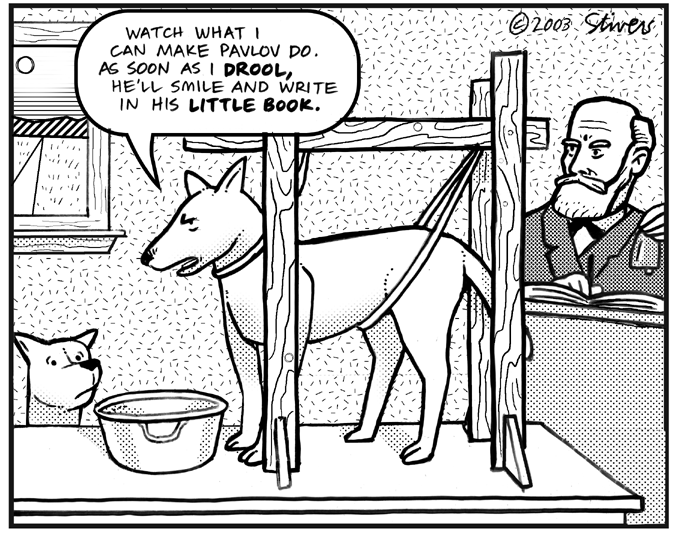
An article published this week in Natural Neuroscience proves that patients in vegetative and minimally conscious states may not be as unaware as you think. Scientists from the University of Buenos Aires, the University of Cambridge, and the Institute of Cognitive Neurology in Argentina used Pavlovian Conditioning on a sample of vegetative patients for any signs of conscious awareness. The researchers played a tone immediately before blowing a puff of air into a patient's eye - pretty advanced stuff, I know. After numerous tries, patients began to blink after the tone, but before the puff. The results show proof that these patients can in fact be conscious and, to some degree, can even recover. A method far cheaper and quicker than extensive brain imaging, classical conditioning has obviously come a long way from Pavlov's dogs.

Friday, September 18, 2009

No Free Rides (Major Post 2)

Imagine you live in a small, growing community known for its very family-friendly, suburban neighborhoods. Due to the increasing number of families moving into the area, local government and other public officials have decided to expand the current public school system. But in order to finance the plans, all residents would have to face higher taxes. Now all we have to figure out is how much should each citizen have to pay?

Should the costs be split equally among everyone in the community? That would seem fair, right? Well, is this solution fair for the Matthews family down the street who send all three of their children to the private high school in the city? They'll get no use out of the school system. What about the Johnson couple who retired last year and are now living on a fixed income? All their children have grown up and left the nest. Should they have to help finance the expansion plans? What about the Chin family? They have twin girls and a younger son all in the public school system? Since they have multiple students currently in the school system, shouldn’t they pay a higher amount than families with one, two or no kids in school?

This simple example outlines the complexities of a long time problem economists have been trying to solve for centuries. The free-rider problem is a result of individuals wanting to consume more than their fair share of a public good or wanting to contribute less than their fair share to the costs of the good's production. How does this problem arise? Well, the situation depends on how much everyone values the good – based on each individual’s utilization of the good and how much each person benefits from it. The most rational approach would call for everyone to pay an amount proportionate to how much they truly value the good. In doing so, project financing could easily be raised and everyone would be happy. Simple, right? So all governments and other committees have to do is ask everyone how much he or she values any public good. But there's just one little problem…most people happen to be very good at lying, especially when it pays off to do so.

Exactly, why would people try to lie? I think the better question is why wouldn't people lie? If highly valuing a public good means paying a higher price for it, why would you want to tell the truth? In the end, if the good obtains the necessary financing and is produced, you would still benefit from it at a cheaper price than you could've/would've/should've paid. In the example above, common sense would determine that families with children that attend the public schools in the community should pay more taxes than those families who would not be utilizing the school system at all. Furthermore, families with multiple children within their household should pay higher than other families with less children in school. Therefore, in order to make an optimal decision, leadership groups need to know how much everyone values a public good. But how would you collect the true value individuals place on certain goods?


Leave it to neurologists to find a resolution. Neuroscientists at CalTech performed a study where they used functional magnetic resonance imaging (fMRI) to track brain activity. In the experiment, participants were given values for different situations that were randomly chosen from a uniform distribution of low values or high values. Scientists were unaware of this figure, but then asked each person if their value was “low” or “high.” The incentive to tell the truth was that for every hypothetical public good that was produced (which was a maximum of half of all the situations due to the parameters of the experiment), participants received a cash reward that correlated to their allotted value. The only way that public goods were produced was if the reported values of all participants exceeded the costs. During the entire process, brain activity of each person was being tracked (A detailed explanation of the experiment can be found here). Researchers found that about 60% of the time, the neuroscientists could predict, from the brain image, whether the “low or “high” value reported by the individual matched the actual figure they were shown.

With this technology, neurologists are able to detect certain areas of the brain that are being stimulated which signify whether an individual has a high or low value for a good in question. Of course, there is no way for an fMRI machine to detect a specific monetary amount, but it does help to deter people from lying about how much he or she values a good. If individuals knew that there was a good possibility they would be caught if they lied, it’s likely they wouldn’t lie in the first place. This probability also increases when individuals find out that lying will lead to consequences, like an increased tax. Such rules and outcomes were established in the experiment, and scientists found that these parameters motivated participants to tell the truth 98% of the time. Therefore, this type of equipment can make great advances in solving the elusive free-rider problem.

If you’re thinking this is just some fancy type of lie detector, you might get your head bitten off. One of the scientists strongly states that this experiment is not about detecting lies, instead, it is about detecting values through brain activity and comparing them to reported values. The scientists were not trying to prove that they can spot when people are lying, but rather predict how much an individual truly values a public good.

After reading the article (gated) and the supporting material, I have a few issues with the experiment. Firstly, if you read the details of the experiment, information is disclosed to all participants that a higher average payoff is more likely to be received if they were all to tell the truth. Lengthy probability equations and complex tables and graphs could persuade anyone to always tell the truth in the experiment, especially if people were participating just to make a quick buck. Therefore, results could be bias since variation would be quite small.

Also, in the experiment, participants were provided a random figure as their value, but I wonder if results would be different if individuals were expected to determine a value on their own? Being given an exact figure is quite different than generating one, especially since most people can’t pick an exact figure when evaluating a public good. Moreover, there are numerous external factors in the real world that could affect how someone values a good. Among them are personal income, discretionary spending, household members, location, number of consumers, etc. Just because a person values a good highly, does not mean they have the means to pay a proportionate amount for it.

Finally, I question the actual role of the fMRI machine. A 60% success rate of predicting participants’ results isn’t extremely efficient and causes one to ask if participants only refused to “free ride” because they were threatened by the daunting presence of an impressive piece of machinery and guys in lab coats. If intimidation is key, it is really worth all the hassle? A simple lie detector test would be much quicker to perform and require a lot less effort – I imagine that the costs for fMRI tests are pretty high in comparison to a simple polygraph machine. I think the experiment is a great step towards solving the free-rider problem and opens up numerous doors towards combating the issue, but if a couple of burly club bouncers can fill the shoes of an fMRI machine, I think neuroscientists can find better things to do with their time. Overall, I’m impressed by the experiment and its findings are very telling, but real world application of the entire process is just a little implausible in my opinion.

Monday, September 14, 2009

America's New Favorite Vice (Major Post)

Check my email, reply to a text message, update my Facebook status, watch a YouTube video, and pay my credit card bill -- without breaking a sweat. The things I can get done on my five minute walk to class. Before my iPhone days I would have given my life in order to own a sleek, smart phone, but who knew that that is exactly what I'd be doing after all.

Last week, the Environmental Working Group (EWG) released a comprehensive report evaluating the amount of radiation emitted by more than 1,000 types of cell phones marketed in the US. The report is aimed at providing cell phone users with information to fill the gap left by vendors neglecting to share cell phone emission levels with their customers. Now anyone in the market for a new cell phone not only has to consider the perfect aesthetics, the memory space, the call quality, etc., but also the amount of radioactive waves invading their delicate brain cells.

This enlightening report adds fuel to the fire of researchers who have been advocating the significant health risks involved with excess cell phone usage. Since the first commercial cellular phone system was introduced to the United States in the 1980s, scientists have performed numerous studies investigating the possible effects of radiofrequency (RF) fields on humans.

One 2008 study performed in Denmark found that mothers who used a cell phone two to three times daily during their pregnancy reported a higher level of behavioral problems in their children, including hyperactivity and difficulty concentrating. These behavioral problems increased by 80% in children who had occasional use of a cell phone by age 7.

And, for all the males reading this, I bet none of you have ever thought that the cell phone in your pocket may be resting just a little bit too close to some precious cargo down there. A published report consolidated the findings of numerous experiments examining the relationship between cell phone usage and male infertility. A study in 2007 tested 361 men in an infertility clinic and found that high cell phone usage decreases sperm counts, mobility, viability and morphology. This was more so the case for men who kept their cell phones close to their waste -- anywhere from 6-8 inches of the genitalia was found to be unsafe.

In addition, a repeated study since the 1990s, reasearchers found:

In series of more than 1,600 animals, subthermal power densities from both pulse-modulated and continuous RF EMFs—including those from GSM (Global System for Mobile Communications) mobile phones—have the potency to significantly open the blood–brain barrier such that the animals’ own albumin passes out of the bloodstream into the brain tissue and accumulates in the neurons and glial cells surrounding the capillaries.
Basically, cell phone radiation is causing the barrier between blood vessels and brain cells to deteriorate.Therefore, if large molecules are permitted to enter brain tissue and interact with neurons, what’s stopping smaller, toxic ones from doing the same?!

The study was investigated further to find how blood proteins found in animal albumin affect brain tissue. Scientists exposed several rats to differing levels of cell phone radiation for two hours. Fifty days after the exposure, it was found that about 2% of rats’ brain cells that were exposed to 0.1 watt or greater were dead or dying due to the accumulation of albumin in the brain.

Of course, there are a few differences between rats and humans, and it is difficult to apply such findings to cell phone use in the real world. Thankfully, Dr. L Hardell of Sweden’s University Hospital, Department of Oncology performed a study researching the cellular and cordless phone use of people who were healthy and those who had been diagnosed with a malignant brain tumor. Hardell and his team found that for every 100 hours of cell phone use, the risk of brain cancer increases by 5%, and that there is a 280% increased risk of brain cancer after ten years.

Although it may seem daunting, no one is telling you to get rid of that Blackberry. A slight change in your everyday use of that Blackberry, on the other hand, is recommended. The 3 billion cell phone users worldwide could increase the use of land lines, if available, cut unnecessary talk, text, and web browser time, and/or invest in a reliable hands-free device, even if you look a little crazy talking to yourself.

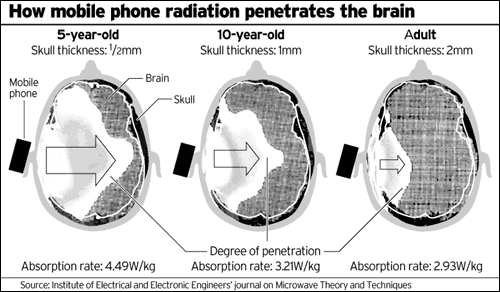
But even with these precautions, there is one group that should definitely be a bit more concerned with published reports. Today, 71% of teenagers in the US own a cell phone, and 51% of them talk to their friends on it every day. About 2 out of 5 teenagers, regardless of cell phone ownership, send text messages on a daily basis. Teenagers are the most active cell phone users out of any demographic, making them the most susceptible to RF fields. Not only is their excessive cell phone use a danger, but also their young, developing neurological system is more conductive to radiation than that of adults. Also, due to their thinner skull and smaller head size, RF penetration is much greater than that of an adult brain (see below).

Finally, since even elementary schools these days have cell phone policies, it is clear that cell phone usage is becoming more prevalent at very young ages, which increases total lifetime exposure to RF fields. Since it is unlikely that teens will cut back on their cell phone usage on their own, it is recommended that parents set some limitations as to prevent dangerous levels of RF fields of accumulating over time. As a former rebellious teen, I know that this is easier said than done. Just remember that they’ll thank you in the long run.

So, as a dedicated owner of a cell phone, what do I think? Fr
om EWG’s report, it is apparent that as technology progresses to give us “genius” phones, radiation emissions, unfortunately, increase proportionately. I do take into consideration the published reports out there regarding the ill effects of RF fields, and recommend everyone to limit their cell phone exposure. There are a number of other communication methods, and even though it's hard to believe, people still have land lines in their homes and offices. Hell, I may even start using that embarrassing Bluetooth earpiece that has been buried deep in my glove compartment for the past year. Still, although the evidence is convincing, the reported findings are far from definite and numerous health organizations and the FDA strongly state that there is "no reason for concern." Ultimately, I do believe it's better to be safe than sorry, but will I be handing over my iPhone for a RAZR anytime soon…over my dead body.